Blockchain Loyalty Programs: How Stablecoins Can Fix Customer Rewards
Written by

Chapter
Share article
Category
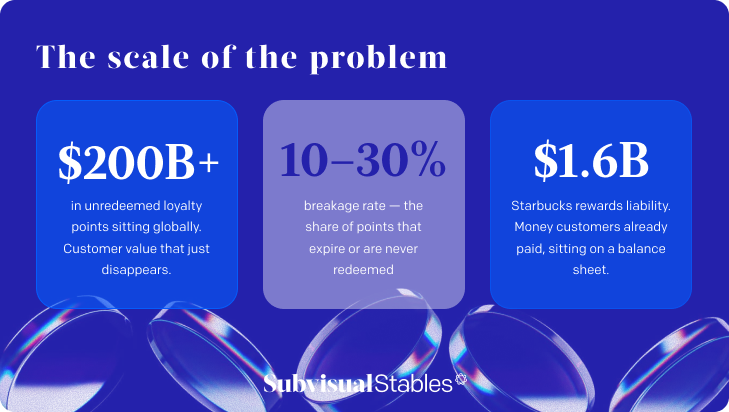
There were over 3.8 billion loyalty program memberships in the United States in 2022. Starbucks holds around $1.6 billion in unspent gift card and rewards liability on its balance sheet. Not revenue they’ve earned, mind you, it’s money customers have already paid them, sitting there, waiting to be spent. Or not spent.
Loyalty programs work. They’re everywhere: coffee shops, airlines, grocery stores, gas stations. The basic deal is simple: spend money with us, earn points, redeem those points for free stuff. But those points aren’t really yours. They’re locked in a system you don’t control, denominated in a currency that only works at one brand, and they can vanish if the company changes its terms of service. Which they do.
What if you could keep the benefits of loyalty programs but remove the geographic locks, the expiration dates, and the lack of control? If we employ stablecoins, this can be achieved.
Why Traditional Loyalty Programs Don't Work
The flow of a traditional loyalty program is straightforward. Customer buys something, brand awards points, customer redeems points for rewards. Behind that simple flow sits a tangle of restrictions: redemption tiers, expiration dates, geographic limitations, currency conversions if you’re traveling, blackout dates for flights, minimum point thresholds, and terms-of-service changes that devalue everything overnight.
If you travel between countries, it gets messy fast. Starbucks Rewards in the U.S. operates separately from Starbucks Rewards in the UK or Japan. Airline miles earned in Europe often can’t be redeemed for flights in Asia without jumping through hoops. Hotel loyalty programs have different redemption rates and availability depending on your home country. Expats and frequent travelers watch their accumulated points become useless when they move.
Despite these problems, loyalty programs deliver real value for brands. They create repeat customers and predictable revenue streams. They collect valuable data on purchasing behavior. They generate massive reserves of unspent points, which improve balance sheets. They build brand stickiness. Once you’re invested in a program, you’re less likely to switch to a competitor.
For customers, the value is murkier. You get free stuff.
Sometimes.
If you remember to use your points. If they haven’t expired. If you’re in the right country.
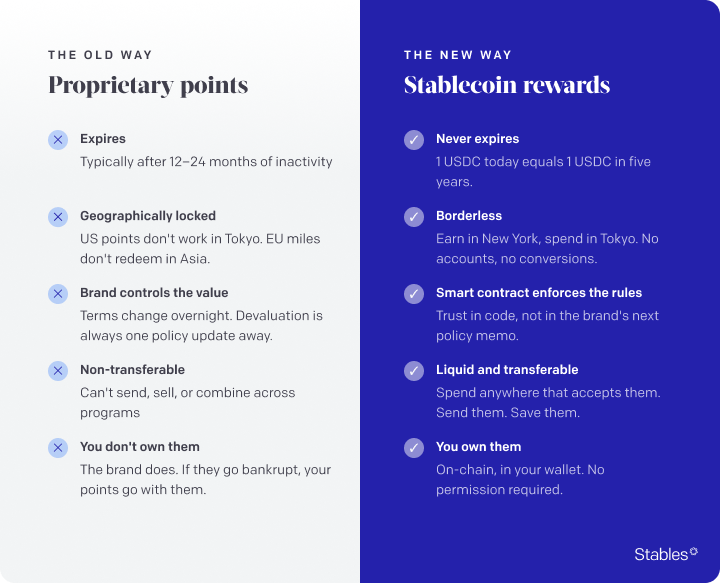
The core problems: Your points aren’t transferable. You can’t send them to someone else. You can’t sell them. You can’t combine points across different brands. The brand can devalue them at any time, and they do. Points expire if unused, typically after 12 to 24 months of inactivity. The brand owns your points, not you. They can change the rules whenever they want. If the company goes bankrupt, your points are worthless.
These aren’t hypothetical problems. They cost customers billions in lost value every year.
How Blockchain Loyalty Programs Work
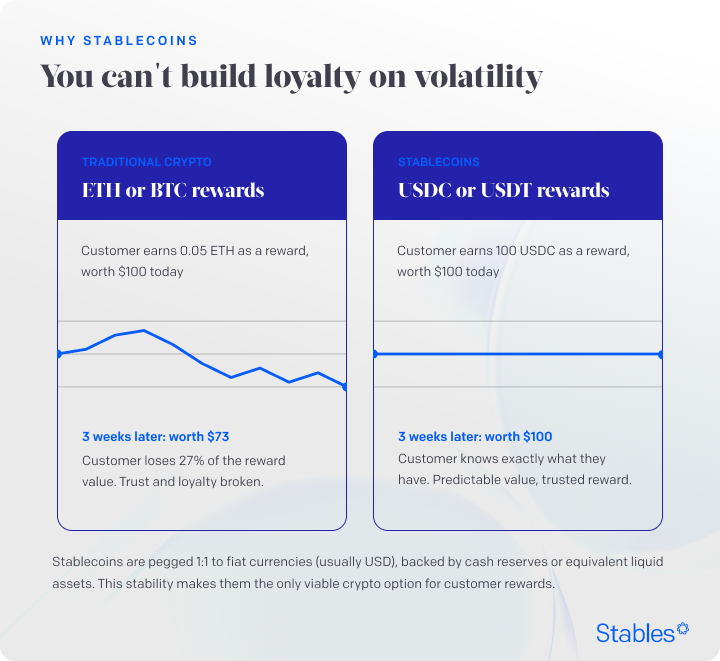
A blockchain loyalty program replaces proprietary points with stablecoins. Stablecoins are crypto tokens pegged to something stable, usually the U.S. dollar or euro. One USDC or one EUROe equals one dollar or one euro. Unlike Bitcoin or Ethereum, the value doesn’t swing wildly. This means brands can reward customers with tokens that have real, stable value instead of arbitrary points that could be worth a free coffee today and half a coffee tomorrow.
The benefits for loyalty programs are concrete. First, borderless rewards. Earn rewards at Starbucks in New York, spend them at Starbucks in Tokyo. No conversion. No separate accounts. Just instant, global value. If you travel frequently, your rewards travel with you.
Second, real value instead of proprietary points. One USDC today equals one USDC tomorrow. No devaluation. No expiration. The value is fixed and transparent.
Third, liquidity and transferability. You can spend your stablecoin rewards anywhere that accepts them. You can trade them, save them, send them to a friend. Your rewards. Your value. Your choice.
Fourth, composability. You could combine rewards from your coffee shop, your grocery store, and your favorite bookstore. In a stablecoin world, that becomes possible because the underlying value is the same across all three. Instead of having separate point balances trapped in separate systems, you have a unified balance denominated in the same currency.
For the customer, this means actual ownership. You don’t need to ask permission. You just use it.
Stablecoins as the Foundation for Better Rewards
Stablecoins are cryptocurrencies designed to maintain a stable value by pegging to a reserve asset like the U.S. dollar, euro, or commodities. The most common stablecoins (USDC, USDT, and EUROe) are backed by fiat currency reserves. Each token is backed 1:1 by real dollars or euros held in reserve accounts.
What are stablecoins used for? Beyond loyalty programs, they make fast cross-border payments, provide a stable store of value in volatile markets, and build programmable payment infrastructure. In the context of blockchain rewards, stablecoins solve the volatility problem that makes other cryptocurrencies impractical for everyday rewards programs.
When you earn stablecoin rewards, you’re earning programmable money. Smart contracts (self-executing code on the blockchain) can automatically trigger reward issuance when specific conditions are met. Customer makes a purchase, smart contract triggers, reward sent instantly. No manual processing. No delays. No “please allow 3-5 business days.”
Brands can get creative with the rules. Tiered rewards: spend $100, earn 2% back. Spend $1,000, earn 5% back. Time-based bonuses: double rewards during specific hours. Referral rewards: invite a friend, both earn 10 USDC. All of it automated. All of it transparent.
The real shift happens in trust. Today’s loyalty programs depend on brand trust. You trust the brand to honor your points. You trust them not to devalue them. You trust them to be there tomorrow. In a blockchain loyalty system, trust shifts from the brand to the code. You don’t have to hope the brand keeps its promise because the code already executes it.
That doesn’t mean brands become irrelevant. But it does mean brands don’t have to be gatekeepers. They can focus on what they do best (building great products and experiences) instead of managing complex loyalty infrastructure.
Building a Stablecoin Loyalty System: Technical Architecture
Let’s say we’ve built it. A loyalty program powered by stablecoins. Customers from anywhere. Instant rewards. Real value. Composable across brands. How does that actually work under the hood?
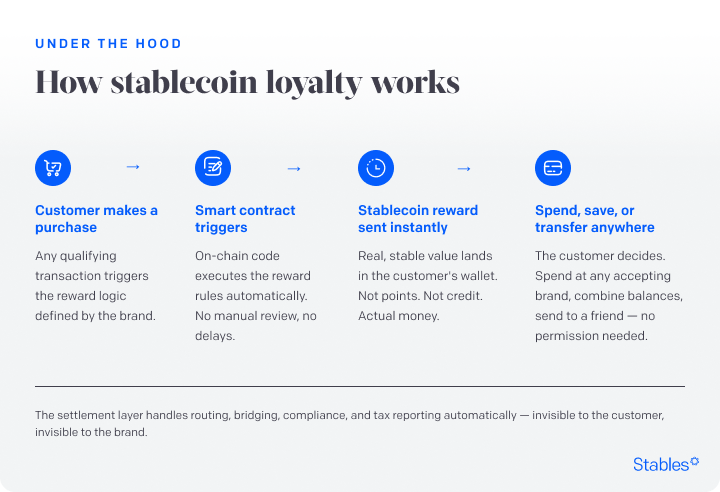
Think of it like a subway system. You see the map. You swipe your card. The train just shows up. But under your feet, there are rails, signals, switches, timing systems, all working together. This is the settlement layer. It connects the app layer to the real-world movement of value. You don’t see it. You don’t interact with it. But without it, none of this works.
Instead of each brand building its own blockchain integration from scratch, they plug into a shared infrastructure layer that handles all the technical complexity. Smart contracts automatically calculate and distribute rewards based on predefined rules. Spend $50, earn 1% back. Hit platinum tier, earn 5% back. All executed without manual intervention.
The platform can operate across multiple blockchains, handling bridging and routing automatically. Customer earns on Ethereum, spends on Polygon? Infrastructure handles it. The backend tracks all transactions for tax reporting, generates receipts, and handles compliance with local regulations automatically.
The customer never sees this. The brand never touches it. But the infrastructure does, and that’s where the real work happens. It’s programmable plumbing for value. Not glamorous, but necessary.
When we talk about building better loyalty programs using blockchain, this is part of the story. You don’t just need a flashy app or a new business model. You need deep, invisible infrastructure that handles all the messy stuff reliably, across borders, at scale.
Problems Blockchain Can't Solve (Yet)
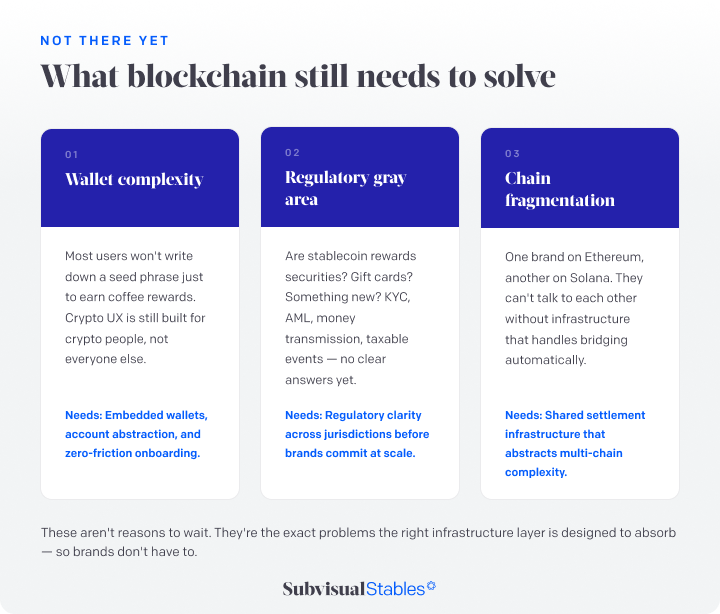
Crypto still has problems. Some are UX problems. Some are regulatory problems. Some are just vibes.
Here’s the elephant in the room: brands like that points are illiquid. Remember that $200+ billion in unredeemed loyalty points? That’s not really a bug for brands. It’s a feature. Breakage is profit. Expiring points mean customers paid for rewards they never got. So why would a brand give customers liquid, transferable, never-expiring value instead?
The honest answer is that it’s better, cheaper, and actually rewards long-term customer loyalty without giving up control. Smart contracts allow brands to define the playbooks they want to see executed. The money in current loyalty schemes is appealing because it’s not real fiat money. It can be controlled within closed platforms. Stablecoins are much more like real money, and they give users more flexibility. But there’s a difference: it’s programmable money. Companies will still be able to define when, how, and if rewards are released. It’s a long-term strategy, but whoever builds this will make a real difference for their customers.
All of this to say: crypto has potential, but also friction. Building a web3 loyalty program like this is possible, but it’s not a weekend hackathon. We need better infrastructure behind the scenes. We need cleaner UX. And we need regulatory clarity.
The Infrastructure Behind Blockchain Rewards
In the old model, customers were stuck in someone else’s system. Point values were controlled by the brand. Redemption options were limited to what the brand allows. Geographic access was a constant headache.
With programmable money and modular infrastructure, you can rewrite loyalty programs and make them cleaner and better for everyone involved. In this new model, customers can earn real value that travels with them globally and instantly. They can combine rewards from multiple brands into one unified balance. They can spend, save, or transfer their rewards however they want. They can carry their loyalty (and their value) with them, platform to platform.
But brands can still define the rulebook. They can still program this money to behave under specific conditions. It’s the best of both worlds.
There’s always hype around new tech. Crypto’s had more than its share. But this isn’t theoretical. It’s real infrastructure solving real problems, especially for people outside traditional payment systems. Stablecoins allow borderless value exchange, accessible rewards for anyone with internet access, and programmable incentives that execute automatically. For loyalty programs, that’s not just a new feature. It’s a new economic foundation.
We’re not saying every brand should jump to blockchain tomorrow or that traditional loyalty programs should disappear. But there’s a better way to do this. The next big loyalty program might not look like a punch card. It might not feel like a points system. It might come from somewhere unexpected, powered by rails no one sees.